
- automatic case unpacker
- case erector
- carton forming machine
- end-of-line packaging automation
- automatic case sealer
- packaging line integration
- tape sealing
- carton supply equipment
Automatic Case Unpacker Trends: What Changes Your Line Decisions
A trend-focused look at automatic case unpackers: how carton supply, tape formats, line integration, and inspection expectations shape what buyers should specify and verify.
Article content
What an automatic case unpacker actually does on a packaging line
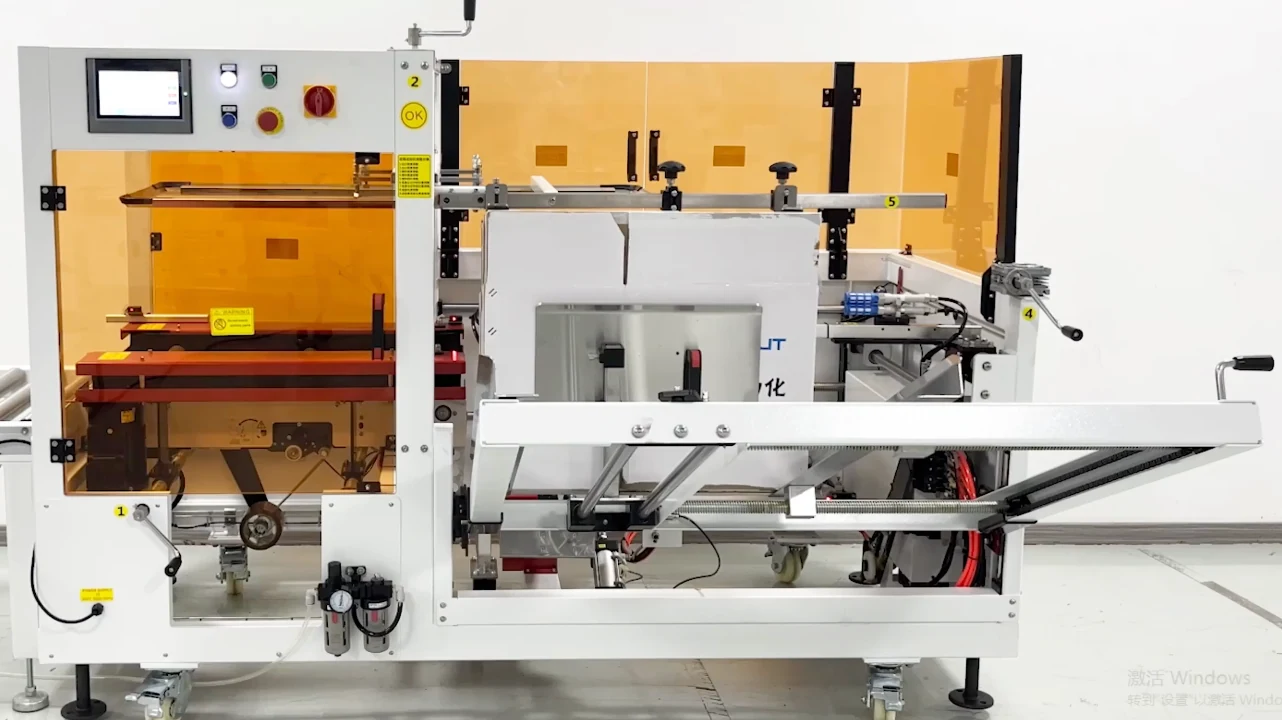
An automatic case unpacker is the station that turns a stack of flat cartons into an open, tape-sealed case ready to be filled. In the supplied product description for model XYM-PACK-001, the sequence is flat-carton picking, case forming, bottom-flap folding, and tape application. Carton dimensions, tape format, and upstream or downstream interfaces are configured per packaging project rather than treated as fixed catalog values.
That definition matters for trend reading. Most changes affecting case supply equipment are not changes to the core mechanical idea. They show up in carton specifications, tape specifications, line interfaces, and the evidence buyers are expected to produce about performance. Each of those areas is a decision point before purchase.
Trend 1: carton supply is being specified as part of the packaging process, not as a commodity input
The unpacker's forming quality depends on the carton board, flute, score lines, and dimensional consistency of what it picks. When buyers change carton suppliers or lightweight board grades, the forming station is often the first place a problem appears: flaps that do not fold cleanly, cases that skew, or tape that misses the seam.
This is a qualitative observation about procurement practice rather than a measured market shift. The practical implication is concrete. Treat the carton specification as part of the equipment specification, and ask for the approved carton range to be recorded in writing before the machine is configured.
Decision actions
- Define the minimum and maximum carton dimensions you expect to run, not just today's main size.
- Record board grade, flute type, and score quality for each carton in the approved range.
- Ask how the forming and flap-folding sequence is set for each size and how changeover is verified.
- Keep a reference sample of each approved carton for acceptance testing.
Trend 2: tape format is becoming a specification item with its own constraints
Tape is often treated as a consumable chosen after the machine is installed. The supplied description for XYM-PACK-001 lists tape format as a project configuration item, which is the more useful framing. Tape width, adhesive type, and roll geometry interact with the sealing head and with the case material.
Buyers who standardize tape across multiple lines gain purchasing simplicity but may narrow the machine's operating window. Buyers who allow multiple tape formats gain flexibility but add changeover and verification work. Neither choice is universally better; the right answer depends on how many carton types and sites you run.
| Decision | What it buys you | What it costs |
|---|---|---|
| Single tape format across lines | Simpler procurement and operator familiarity | Less freedom to match tape to unusual carton or board types |
| Multiple approved tape formats | Flexibility across carton ranges and sites | Changeover steps, spare-part variety, and more verification |
| Tape format fixed at order | Clear acceptance criteria | Later changes may require machine adjustment |
Trend 3: line integration is moving from mechanical fit to data and control fit
An unpacker rarely runs alone. It hands cases to a filler, a sealer, or a conveyor, and it receives empty cartons from a magazine or an upstream supply step. The supplied description for XYM-PACK-001 treats upstream and downstream interfaces as configured items. That framing reflects a broader pattern in end-of-line automation: buyers now ask about signal handshakes, fault handling, and line-stop behavior at the same time as they ask about speed.
The related Automatic Case Sealer, model XYM-PACK-002, is described as folding carton flaps and applying top and bottom tape, with drive arrangement, carton range, tape format, and conveyor interfaces selected for the approved process. When unpacker and sealer are specified together, the interface between them deserves its own review. A case that is formed correctly but presented at the wrong height or pitch will still stop the line.
Questions that expose integration risk early
- Which station controls line speed, and what happens to the unpacker when a downstream station pauses?
- What signals are exchanged at each interface, and who is responsible for testing them?
- How are jams detected and cleared, and does clearing require stopping the whole line?
- What conveyor height, pitch, and accumulation buffer are assumed?
Trend 4: inspection expectations are spreading from process equipment to packaging equipment
In photovoltaic manufacturing, inspection and calibration equipment such as the Graphite Boat Calibration & Inspection Equipment (model XYM-PV-001) is described with position inspection, calibration workflow support, and result recording. That product sits in a different process area from case supply, so it is not evidence that packaging machines now include the same functions. It is, however, a useful reference point for how buyers in technical industries tend to frame requirements: measurement, recorded results, and system interfacing.
The cautious inference is that packaging equipment buyers increasingly ask what the machine records and how those records can be retrieved. Whether an unpacker logs case counts, fault events, or changeover settings depends on the project configuration. Buyers should ask rather than assume.
What to verify
- Which events the control system records, and for how long.
- Whether records can be exported and in what format.
- Whether the machine can exchange status data with a line or plant system, and over which interface.
- How recorded data is used during acceptance testing.
Trend 5: labor and changeover economics are shaping machine selection
Case supply is repetitive work, and the case for automation usually rests on reducing manual handling and stabilizing output. The size of that benefit depends on how often you change carton sizes, how many operators the line needs, and how quickly faults are cleared.
Rather than accepting a general productivity claim, build a simple comparison for your own line. Count the manual steps per shift, the changeovers per week, and the typical duration of a stoppage. Then ask the supplier which of those steps the configured machine removes and which remain. This keeps the evaluation tied to your operation instead of to a brochure.
| Evaluation input | Why it matters | What to ask |
|---|---|---|
| Carton sizes per week | Drives changeover frequency and adjustment effort | How is each size set, and how is it confirmed? |
| Operators per shift on case supply | Defines the labor baseline for comparison | Which tasks does the machine take over? |
| Typical stoppage duration | Shows how much fault recovery affects output | How are jams detected and cleared? |
| Carton supply method | Affects magazine loading and replenishment rhythm | How often must cartons be reloaded? |
How to separate evidence from inference when suppliers discuss trends
Trend language is easy to produce and hard to check. A useful discipline is to ask, for each claim, whether it is a specification, a measured result from a comparable installation, or an expectation. Specifications can be verified against drawings and approved ranges. Measured results need a defined test, carton type, tape format, and line condition. Expectations should be treated as open questions.
Apply the same rule to this article. The product descriptions supplied for the unpacker, sealer, and graphite boat equipment are specifications and scope statements. Statements about procurement practice and buyer expectations are qualitative observations, not measured market data. No growth rates, market shares, or dated forecasts are asserted here because no sourced figures were supplied.
A short specification checklist before you request a quote
- Carton range: minimum and maximum dimensions, board grade, flute, and score quality for every size you plan to run.
- Tape format: width, adhesive type, and roll geometry, plus whether more than one format must be supported.
- Upstream and downstream interfaces: conveyor height and pitch, signal handshake, line-stop behavior, and who tests each interface.
- Changeover: steps, tools, expected duration, and how the setting is confirmed.
- Fault handling: detection method, clearing procedure, and whether clearing stops the line.
- Records and data: what is logged, how it is exported, and which system interfaces are included.
- Acceptance: the cartons, tape, and line conditions used for the test, and the pass criteria agreed in advance.
Send that checklist with your inquiry. A supplier working from your carton range, tape format, and interface assumptions can respond with a configured proposal instead of a generic specification sheet, and you can compare responses on the same basis.
Project discussion
Discuss an automation requirement with our team
Share the workpiece, process sequence, layout, and interface requirements for a project-based technical review.