
- automatic case sealer
- case sealing machine
- carton sealing equipment
- top and bottom tape sealing
- packaging line integration
- case sealer selection
- automatic case unpacker
- end-of-line packaging
Automatic Case Sealer Selection Guide: Matching Machine Configuration to Your Packaging Line
A practical guide to specifying an automatic case sealer: how drive arrangement, carton range, tape format, and conveyor interfaces determine whether a machine fits your line, plus verification steps and trade-offs.
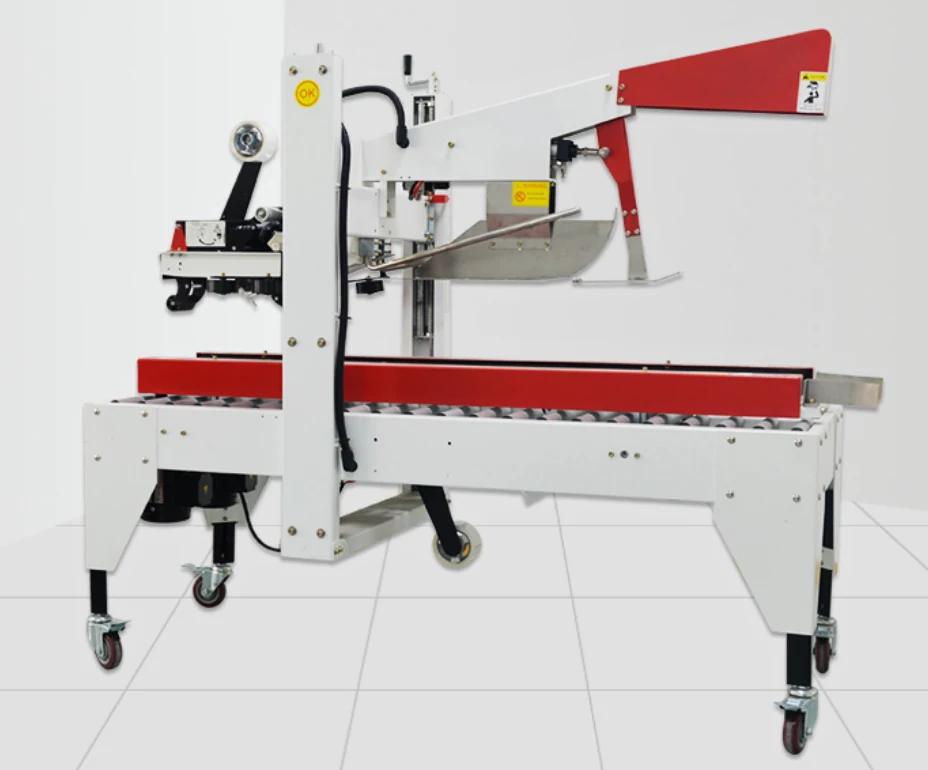
Article content
What an automatic case sealer does — and what it does not decide for you
An automatic case sealer folds the top flaps of a filled carton and applies tape to close it. In a packaging line, it sits after filling and before palletizing or labeling. The machine itself is a mechanism: flap-folding guides, a tape head, a drive system, and a conveyor interface. What it cannot do is compensate for a carton that was never designed for automated sealing, a fill process that leaves flaps misaligned, or a line whose speed and carton mix change faster than the sealer can be adjusted.
That distinction matters during selection. Most disappointing case-sealer projects trace back to a mismatch in one of four configuration areas — drive arrangement, carton range, tape format, and conveyor interfaces — rather than to a defective machine. This guide walks through each area, shows how to verify a candidate machine against your actual cartons, and flags the trade-offs that are easy to miss in a quotation.
The four configuration decisions that determine fit
For the Automatic Case Sealer (model XYM-PACK-002), the supplied product information states that drive arrangement, carton range, tape format, and conveyor interfaces are selected for the approved packaging process. Those four items are also the right checklist for any sealer evaluation, regardless of supplier. Treat a quotation that does not address all four as incomplete.
1. Drive arrangement: side-drive versus top-drive
The drive arrangement determines how the carton is pulled through the sealing station. Side-drive machines grip the carton on its side panels; top-drive machines grip it from above. The choice affects stability for tall or narrow cartons, access for jam clearing, and how the machine behaves when carton weight or fill distribution varies.
Ask for the drive arrangement to be stated explicitly in the offer, together with the carton sizes and weights it was dimensioned for. A machine rated for a carton range on paper may still perform poorly at the extremes of that range if the drive was dimensioned around the middle.
2. Carton range: the specification that hides the most risk
Carton range is usually quoted as minimum and maximum length, width, and height. The risk is that a single machine covering a very wide range often needs manual changeover or compromise settings. Two questions expose this quickly:
- How many carton sizes will run in a typical week? A line running one or two sizes is a different problem from a line running ten.
- What changeover is required between sizes, and who performs it? If changeover involves tools or re-setting guides, the effective line speed drops every time the size changes.
Also check the carton construction itself. Flap length, board grade, and whether the carton is filled to the top all influence flap folding. A sealer cannot fold flaps that are too short, too warped, or blocked by overfilled product.
3. Tape format: width, adhesive, and head type
Tape format covers tape width, core size, and adhesive type. The sealer's tape head must match the tape you intend to buy, not the other way around. Adhesive choice depends on board surface, dust levels, and storage conditions — a tape that performs in a clean, dry room may fail on a recycled board with a dusty surface or in a cold warehouse.
Confirm with the supplier which tape widths and core sizes the head accepts, and whether top-only or top-and-bottom sealing is configured. The XYM-PACK-002 product information lists top and bottom tape sealing as a feature, but the actual configuration for your project should be confirmed in the approved packaging process.
4. Conveyor interfaces: where most integration problems appear
A sealer is rarely a standalone machine. It connects to an infeed conveyor, an outfeed conveyor, and often a case erector or unpacker upstream and a palletizer or labeler downstream. Interface details that need to be agreed before order include:
- Conveyor height and width at the infeed and outfeed
- Transfer method between sections (belt, roller, or dead plate)
- Accumulation strategy and how back-pressure is handled
- Signal exchange with upstream and downstream equipment (start/stop, jam, fault)
- Direction of flow and available floor space around the machine
If the sealer is part of a line that also includes case forming, the companion Automatic Case Unpacker (XYM-PACK-001) picks flat cartons, forms cases, folds bottom flaps, and applies tape. Its carton dimensions, tape format, and upstream or downstream interfaces are also configured per project, so the two machines should be specified against the same carton list and the same line speed target.
A comparison framework for shortlisting sealers
The table below turns the four configuration areas into evaluation fields. It is a framework, not a product comparison — fill it with the values from each candidate offer.
| Evaluation field | What to record | Why it matters |
|---|---|---|
| Drive arrangement | Side-drive or top-drive; rated carton weight | Affects stability at carton extremes and jam recovery |
| Carton range | Min/max L×W×H; number of sizes in weekly production | Wide ranges often mean manual changeover and slower effective speed |
| Changeover | Method, tools required, time per size change | Determines real throughput on mixed-size lines |
| Tape format | Width, core size, adhesive type, top/bottom configuration | Must match the tape you can actually source and store |
| Conveyor interface | Height, width, transfer type, signal exchange | Most integration delays originate here |
| Line speed | Rated speed at your carton sizes, not just maximum | Maximum speed is often quoted at one favorable carton size |
| Verification | Carton samples tested, acceptance criteria | Converts paper specifications into demonstrated performance |
How to verify a sealer before committing
Specifications describe intent; samples demonstrate behavior. A practical verification sequence for a case sealer looks like this:
- Send a representative carton set. Include the smallest and largest cartons, the heaviest fill, and the board grade you actually buy. If you plan to change carton suppliers, include a sample from the alternative source.
- Agree acceptance criteria in writing. Typical criteria include seal position within a stated tolerance, tape adhesion without lifting at the flap edge, no crushed corners, and stable carton tracking through the machine.
- Test at the extremes, not the middle. Run the smallest and largest cartons at the target line speed. A machine that performs well on a mid-size carton can still fail at the edges of its stated range.
- Confirm changeover on your own carton mix. Time a size change with the people who will actually do it during production.
- Check the interface drawing. Ask for a dimensioned drawing showing conveyor heights, infeed and outfeed positions, and signal connections before shipment.
If a supplier cannot or will not run carton samples, treat the specification as unverified and plan for on-site commissioning trials with a defined fallback.
Trade-offs buyers should expect to negotiate
No sealer configuration is best on every axis. The common trade-offs are:
- Wide carton range versus changeover speed. A machine covering many sizes usually needs more adjustment between them. If your mix is stable, a narrower range with faster changeover is often the better line decision.
- Maximum speed versus stable speed. Quoted maximum speed is typically achieved under favorable conditions. Specify the speed required at your actual carton sizes and fill weights.
- Top-and-bottom sealing versus top-only. Bottom sealing adds a tape head and consumable cost but improves closure integrity for heavier or taller cartons. The right choice depends on the carton and the downstream handling.
- Standalone machine versus integrated line. A standalone sealer is simpler to install but may need manual carton transfer. An integrated line with an unpacker or erector reduces manual handling but raises the coordination burden during specification.
Where the sealer sits in a broader automation project
Case sealing is one station in a chain. Upstream, the Automatic Case Unpacker (XYM-PACK-001) supplies formed cases; downstream, palletizing and labeling follow. If the same project also covers photovoltaic production equipment, the Graphite Boat Calibration & Inspection Equipment (XYM-PV-001) is a separate product line for checking graphite-boat alignment and supporting calibration work in photovoltaic cell production, with project configurations that can combine vision measurement, motion control, result recording, and production-system interfaces. The two product lines serve different processes; they should not be conflated in a single specification.
For packaging projects, the practical sequence is to fix the carton list first, then the line speed target, then the interface drawing, and only then compare machine offers. Suppliers who ask for the carton list and line layout before quoting are usually easier to work with during commissioning.
Questions to put to any case sealer supplier
- Which drive arrangement is proposed, and what carton weight was it dimensioned for?
- What is the tested carton range, and what changeover is needed between sizes?
- Which tape widths, core sizes, and adhesive types does the head accept?
- Can you provide a dimensioned interface drawing before shipment?
- What acceptance criteria will be used during the factory or on-site trial?
- How are jams detected and cleared, and what safety measures guard the sealing station?
Answers to these questions belong in the purchase order or its technical annex, not only in sales correspondence. That is the difference between a sealer that fits the line and one that fits only the quotation.
Project discussion
Discuss an automation requirement with our team
Share the workpiece, process sequence, layout, and interface requirements for a project-based technical review.