
A Technical Guide to Graphite Boat Alignment Inspection in Wafer Processing
Article content
Table of Contents
1. The Core Problem in the PECVD Process
1.1. Silicon Wafer Loading Challenges
1.2. The High Cost of the Breakage Rate
2. How Graphite Boat Alignment Inspection Works
2.1. Using a Machine Vision System
2.2. Thermal Expansion Compensation
3. Data Comparison: Mechanical vs. Vision Alignment
4. Integrating with Robotic Handling
5. Managing the Graphite Carrier Over Time
6. Industry FAQ
Silicon wafers are very thin. They break easy. You need to bake them in a hot furnace. You put them in a graphite boat first. But if the boat is not in the exact right spot, you have a big problem. The robot will smash the fragile wafer into the hard graphite edge.
You lose money when this happens. Graphite boat alignment inspection stops this bad crash. It uses cameras. It checks the exact position of the boat before the robot moves. We will look at how this system works.
We do not use big fancy words here. We look at the basic factory facts. You need to know these facts. It helps you keep the solar cell line running fast and safe.
1. The Core Problem in the PECVD Process
The PECVD process makes the solar cell work. It puts a special chemical coat on the wafer. The furnace gets very hot. So, you must use a graphite carrier to hold the wafers. Graphite can take the crazy heat without melting.
1.1. Silicon Wafer Loading Challenges
The boat holds hundreds of wafers. The slots for the wafers are very narrow. A slot is maybe 2 millimeters wide. Silicon wafer loading must be perfect. The robot holds the thin wafer. It moves very fast.
If the boat is sitting slightly crooked, the slot is not where the robot thinks it is. The robot pushes the wafer. It hits the solid graphite wall instead of the empty slot. Crack. The wafer shatters into small pieces.
1.2. The High Cost of the Breakage Rate
When a wafer breaks, the breakage rate goes up. But it is not just one lost wafer. The small sharp pieces fall down inside the boat. They block other slots.
You have to stop the whole machine. A worker has to open the loader. They have to use a vacuum to suck up the broken pieces. You lose 30 minutes of production time. In a big factory, 30 minutes of dead time costs thousands of dollars.
2. How Graphite Boat Alignment Inspection Works
You can not use human eyes to line up the boat. It is too small and too fast. You absolutely need automated graphite boat alignment inspection.
2.1. Using a Machine Vision System
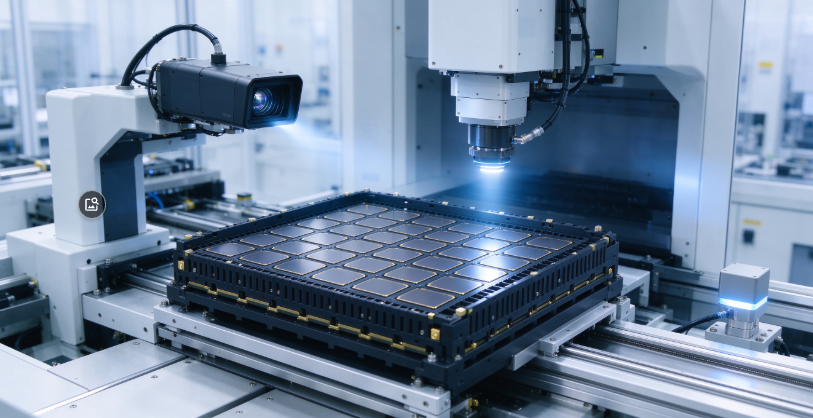
Factories use a machine vision system to do this job. They put smart cameras above the loading zone. When the empty graphite boat rolls into the station, the camera takes a fast picture.
The software looks for the edges of the boat. It finds the exact first slot. It calculates the X and Y position. It calculates the rotation angle. It sends this exact math to the robot. The robot adjusts its hand. Then it puts the wafer in perfectly.
2.2. Thermal Expansion Compensation
There is a tricky physics problem here. The boat goes into the hot oven. Then it comes out to get new wafers. It is still very warm. When graphite gets warm, it grows a little bit. The whole boat gets longer.
If the boat is hot, the slots move. The distance between slot 1 and slot 400 is longer than when it is cold. Good vision software has thermal expansion compensation. The camera measures the total length of the boat right now. It does the math to find every single slot, even if the boat stretched. The robot does not miss.
3. Data Comparison: Mechanical vs. Vision Alignment
Some old factories still use mechanical pushers to line up the boat. They push metal blocks against the graphite to force it straight. This is bad. It breaks the graphite. And it is not exact.
We use numbers to show why cameras are better. Factory engineers use this data to upgrade their lines. This data comes from standard machine vision application notes in the solar industry.
Feature | Mechanical Push Alignment | Machine Vision Inspection |
Position Accuracy | +/- 0.5 mm | +/- 0.05 mm |
Wafer Breakage Rate | 0.5% - 1.0% | Less than 0.05% |
Thermal Expansion Fix | No (Causes late-slot crashes) | Yes (Calculates real-time size) |
Graphite Wear & Tear | High (Scrapes the edges) | Zero (Non-contact) |
Inspection Speed | 2 to 3 seconds | Under 0.5 seconds |
Note: Accuracy numbers depend on the megapixel size of the camera and the lens quality.
4. Integrating with Robotic Handling
The camera is just the eye. The robotic handling is the hand. They must talk to each other very fast. Usually, they talk over an Ethernet cable.
The camera says, 'The boat is shifted left by 0.3 mm and rotated 1 degree.' The robot brain hears this. It changes its path in one millisecond. The robot arm moves a little bit left. It turns its wrist 1 degree. It slides the wafer in. It is a beautiful dance. It happens 300 times for one boat.
5. Managing the Graphite Carrier Over Time
The graphite carrier gets dirty. The PECVD chemical coat gets on the boat too. It turns the boat weird colors. It makes it shiny or very dark.
This makes it hard for the camera to see the slots. The contrast goes away. You need very strong LED lights to fix this. You use special blue or red lights to make the slot edges look sharp. But eventually, you must take the boat offline. You have to wash the chemical coat off so the camera can see it again.
6. Industry FAQ
Why do we use graphite for the boat?
Graphite handles extreme heat very well. It does not melt at 1000 degrees. Also, it does not release bad chemicals into the oven. If you use steel, the steel melts and ruins the silicon wafers.
How fast is the vision alignment check?
It is very fast. A good industrial camera takes the picture and does the math in under 0.5 seconds. It does not slow down the factory production line at all.
What causes the boat to sit crooked on the track?
The automated guided vehicle (AGV) or the conveyor belt brings the boat in. Belts vibrate. Rollers get old. The boat bumps around. It is impossible to make it stop in the exact same millimeter every single time. That is why you need the camera check.
Can the camera see a broken wafer already in the slot?
Yes. Many advanced vision programs do a double check. They look for boat alignment first. Then they check if any slot is already full or has a broken piece blocking it. If it sees a block, it tells the robot to skip that slot. This saves a double-crash.
How often do I need to clean the camera lens?
Factory air has dust. You should wipe the camera lens with a clean alcohol cloth once a week. If the lens is dirty, the software gets confused. It gives bad coordinates to the robot.
Project discussion
Discuss an automation requirement with our team
Share the workpiece, process sequence, layout, and interface requirements for a project-based technical review.